Water has a long memory. It remembers the faintest grade, the tight layers of Pasadena clay, the seams between turf and concrete, and the shortcut that gutter downspouts carve into a bed of mulch during the first big storm. If your yard floods by the porch or tracks mud across a new paver patio, it is not a fluke. It is a symptom of a drainage system that relies on luck rather than design.
Over the past two decades working across Pasadena and the San Gabriel Valley, I have seen yards with impeccable plant palettes fail because water had nowhere smart to go. I have also seen modest gardens without big budgets perform beautifully in back‑to‑back storm cycles because the drainage was thoughtful, layered, and simple. This article focuses on three tools that consistently work in our local conditions when they are designed correctly: French drains, dry creek beds, and permeable pavers. Along the way, I will connect the dots to retaining walls, artificial turf bases, xeriscape choices, and the details that separate a quick fix from a durable solution.
What makes Pasadena drainage different
Topography and soil decide almost everything. Much of Pasadena sits on alluvial fans coming off the San Gabriel Mountains. In some neighborhoods you get sandy loam and decomposed granite that percolate fast. Move a few blocks, and you hit dense clay that seals in winter and bakes hard by August. On a single lot you can cross both. Add roof areas that shed thousands of gallons in a single storm, older properties with shallow foundations, and a city storm system designed to move water to the Arroyo quickly, and you have a setting where small grading errors turn into standing water.
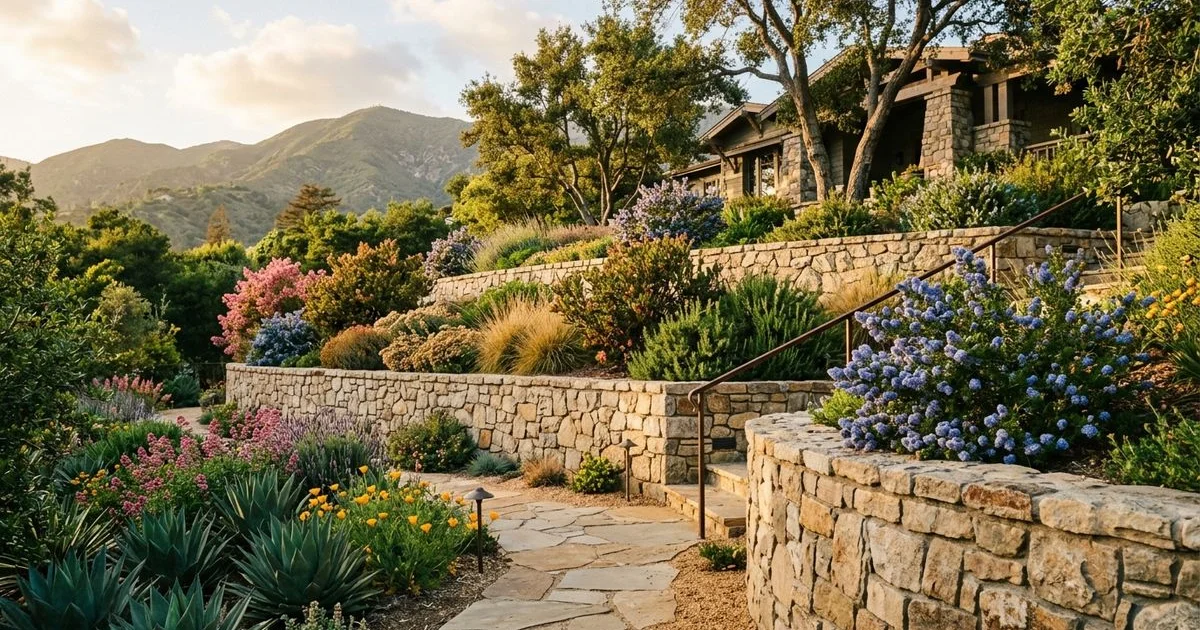
The rain is feast or famine. In a typical year we may see gentle events that barely wet the mulch. Then a Pineapple Express parks over the region, and you get 2 to 5 inches in 24 hours. During the El Niño of 2023, many properties took in more water in one week than they had in five previous years combined. If you design yard drainage in Pasadena for a friendly drizzle, you are designing for failure. If you design only for the worst case, you risk overspending or creating features that dominate the space. The art is balancing peak capacity with everyday function and beauty.
How water moves through a yard
Every successful drainage plan starts with a clear map of how water wants to move today and how we want it to move tomorrow. Water travels three ways on a residential site. Across the surface, along the tight boundary where hardscape meets soil, and within the soil, both through pores and along impermeable layers. When a paver patio holds a puddle on one corner, it is almost always because subsurface water is trapped beneath the compacted base, or runoff flows to the lowest joint. When lawn edges stay soggy, it is often because the base material for artificial turf or a walkway forms a dam.
I rely on a laser level and a simple 10 foot straightedge as much as any tool. A quarter inch of fall per foot sounds small, yet it controls whether water drains or hides. A downspout set to splash on mulch will carve a channel unless that flow is intercepted. A raised planter with an impermeable liner can act like a bathtub if we do not provide an outlet. For hardscape design in Pasadena, those realities shape every choice on slope, elevations, and pipe routing.
A practical site walk
Before recommending a French drain or a creek bed, I walk the property in two loops. First, I trace hard boundaries. Curb, driveway, house foundation, garage slab, and existing patios. Second, I follow roof lines and the highest toe of the yard where water begins to move. Pasadena homeowners can learn a lot with a simple checklist during a rainy day.
- Note where water first crosses a hard edge, such as the sidewalk seam or the garage threshold. Photograph the end of every downspout and where that flow goes after 10 feet. Look for soil staining or algae on walls that show chronic splashback. Probe with a hand trowel in three spots to feel whether the top 6 inches are sandy or sticky. Watch the lowest corner of the lot to confirm whether it drains to the street, a neighbor, or nowhere.
Those five snapshots tell me almost everything I need for a concept plan, whether the project is a small front yard landscaping in Pasadena or a full outdoor living design with patios and retaining walls.
French drains, done the right way
A French drain is not just a perforated pipe buried in gravel. A good one intercepts water moving through the soil and carries it to a reliable discharge. On a sloped lot, that might be a curb core to the street. On a flat lot, it might be a daylight outlet at a lower corner, a sump with a pump, or a tie‑in to a larger collector line.
Sizing matters. For Pasadena yards on clay, I start with a trench 12 to 18 inches wide and 18 to 24 inches deep for garden areas, larger along footings. The trench gets lined with a nonwoven geotextile that allows water in but keeps fines out. I place 4 inch perforated SDR‑35 or Schedule 40 pipe set on grade with the holes down, then fill with angular 3/4 inch gravel to within 3 to 4 inches of finish grade. Fabric wraps over the top to prevent soil migration, then topsoil or mulch finishes the surface. If the drain will sit under a lawn, I set it deeper or cap with sand so the root zone stays even.
I avoid sock‑wrapped pipe. The fabric sock clogs quickly in Pasadena’s fine clay. Solid pipe sections under driveways and patios reduce the risk of infiltration near hardscape bases that do not like saturation. Where tree roots are likely, I add cleanouts with threaded caps every 50 to 75 feet. A small bottle brush on a snake can clear early buildup before it becomes a problem.
Two numbers guide the slope. Absolute minimum is 1 percent, or 1 foot of fall per 100 feet of pipe. Preferred is closer to 2 percent if the site allows it. In tight urban lots you will not always get those numbers, especially if your outlet is close in elevation. That is when a gravel reservoir becomes the hero. A wider, deeper trench or a modular chamber, sometimes called an infiltration gallery, temporarily holds water and releases it slowly. In our local clay, infiltration is variable, so I still give that gallery a relief line to a safe discharge. When a patio contractor in Pasadena builds new hardscape, I prefer to route yard drainage lines outside the patio footprint so any backup does not travel under the slab.
French drains have limits. They do not fix a backyard that sits 4 inches lower than the neighbor’s lot unless you give that water a place to go. They are not a license to divert water onto the sidewalk. They need protection at their outlets so rodents do not enter. When a hardscape builder in Pasadena adds a retaining wall at the downhill side of a yard, we add a second, independent drain behind the wall for hydrostatic pressure and keep it separate from the yard system to avoid overloading one line.
Dry creek beds that carry their weight
A dry creek bed is one of the most useful and beautiful tools we have in backyard landscaping in Pasadena. The idea is simple. You create a shallow, meandering channel https://maps.app.goo.gl/LYozuPHCFQ34CNMf6 lined with rock of varied sizes that collects and conveys runoff during storms, then reads as a natural feature the rest of the year. It can be entirely passive, or it can connect to a basin, a rain garden, or a culvert to the street.
What separates a creek bed that works from one that spills onto the path is attention to hydraulics. The cross section needs a gentle V or wide U, not a sharp trench. Depth often starts at 6 to 8 inches at the upper reach, building to 12 or even 18 inches where multiple flows converge. Width ranges from 18 inches in a side yard to 4 feet or more in a primary run. I use angular cobble and river rock in a blend, with the largest stones set like armor on bends and at inlets to break velocity. Underlayment is a tough landscape fabric, and I prefer to line the bottom with compacted decomposed granite before setting rock. A narrow ribbon of pea gravel along the center lets fines drop out where you can rake them seasonally.
Planting makes the difference. In a drought tolerant garden in Pasadena, you can flank the creek with deer grass, blue fescue, yarrow, and California gray rush, all tolerant of the brief wet feet that come with storms. On the upper banks, manzanita and salvia handle heat and look right with stone. Avoid placing mulch inside the channel. It will float. Use it on the banks and pin it with jute netting if the first storms are expected soon after install.
One of my favorite projects was a front yard landscaping renovation in the Lower Arroyo. The street sat a foot above the lawn, so curb discharge was not an option. We built a dry creek that collected two downspouts and the front walkway runoff, then spread the water into a long bioswale planted with rushes and sedges before it infiltrated into a gravel gallery. In the largest storm that winter, the creek carried a shallow sheet of water for six hours and never threatened the porch. On normal days it reads as a sculpted ribbon of stone beneath olive trees.
Permeable pavers for patios and driveways
Permeable interlocking concrete pavers have a reputation as a driveway solution in wetter climates, but they make a lot of sense for patio design in Pasadena as well. Instead of a traditional sand‑set system with tight joints and a compacted base that sheds water, permeable pavers have wider joints filled with clean aggregate and a base made of open graded rock. Water drops through the joints, stores temporarily in the base, and either infiltrates into the soil or exits through an underdrain to a discharge point.
A typical section for a paver patio in Pasadena starts with 12 to 18 inches of open graded stone, often 3/4 inch and 3/8 inch blends, topped with a 2 inch setting bed of small chip stone. The pavers lock together with spacers that maintain joint width, and the joints are filled with clean aggregate, not polymeric sand. Edge restraints keep the field stable. For driveways, the base gets thicker, often 18 to 24 inches depending on subgrade strength. Many homeowners pair permeable patios with synthetic turf insets. Artificial grass in Pasadena sits on a free draining base as well, so the whole surface acts as a sponge that relieves pressure on storm lines.
Maintenance is modest. A shop vac pass once or twice a year keeps joints open in areas with heavy leaf litter. If a joint clogs in clay heavy yards, you can agitate the surface with a stiff brush and reapply chip stone. Avoid sealing or power washing at high pressure, which can damage joint material. Because the base stores water, it is wise to keep the paver finish at least 4 to 6 inches below the house threshold and confirm that the system has an overflow, typically a solid pipe to the street or to a lower garden area.
Coordination is critical when a hardscape company in Pasadena builds mixed surfaces. If a permeable patio drains to a dry creek, both need adequate capacity. If a permeable driveway sits next to a concrete walkway, the walkway needs a cross slope that does not dump onto the driveway edge where sediment will collect. Smart edges make maintenance easier.
Matching the solution to the site
Each of these tools solves a different problem. French drains intercept water moving through soil. Dry creek beds move and display water moving across the surface. Permeable pavers capture rainfall where it lands and let it vanish into a robust base. Many yards need some of each, tied together by light grading and a reliable discharge.
- Choose a French drain when a side yard stays squishy, when a slope leaks into a lower patio, or when the toe of a retaining wall needs relief. Choose a dry creek bed where roof and patio runoff cross landscape on the way to the street, where a side yard needs a defined channel, or where you want stormwater to add beauty instead of mess. Choose permeable pavers when you plan a new patio or driveway and want to eliminate puddles at the source while reducing runoff to the street.
These choices live inside a larger plan. A retaining wall builder in Pasadena knows that every wall taller than a few courses needs a perforated drain line and a free draining backfill. That wall drain should never be tied into a roof downspout line that may surge hard. A patio contractor in Pasadena understands that it is cheaper to cut in area drains and conduits during excavation than after the stone is set. Garden landscaping in Pasadena benefits when drip tubing routes above drain lines so maintenance crews do not pierce pipe while planting.
Integrating drainage with outdoor living
Beautiful outdoor living spaces in Pasadena depend on the invisible work that supports them. When we lay out a kitchen, seating wall, and fire feature, we also sketch the fall of the patio, the line of a trench drain that keeps water off the cooking area, and the route of a 4 inch collector to a safe outlet. If we design a pergola, we plan where its footings shed water and how a downspout will connect to the yard system. If a client wants artificial turf installation in Pasadena for a play lawn, we specify a free draining base and confirm that the subgrade falls away from the house so the turf does not become a bathtub.
Luxury outdoor living in Pasadena often includes multiple zones. A sun deck, a shaded dining terrace, and a spa court might each have different drainage approaches, yet they feed one backbone. Clear schematics prevent surprises. The best landscape contractor in Pasadena will include as‑builts that show cleanout locations, pipe sizes, and elevations. Five years later, when you add a new planter or swap a tree, that map saves time and money.
Sizing for Pasadena storms
Let us talk capacity without turning this into a hydrology textbook. Roof area is easy to measure. Take your plan dimensions and include any overhangs. A 1,500 square foot roof in a 2 inch rain produces roughly 1,875 gallons. In a 4 inch event that doubles. If four downspouts share the load, each sees around 470 to 940 gallons across the storm. That volume either needs to infiltrate or be moved. Yard slopes add more flow as the ground saturates and surface water travels.
For French drains, I often think in linear footage and storage volume. A trench 18 inches wide and 18 inches deep, filled with 40 percent void gravel, stores about 1 gallon per linear foot for each inch of depth. Over a 50 foot run you can hold several hundred gallons temporarily as it moves toward the outlet. For dry creeks, cross sectional area and slope control capacity. A 3 foot wide, 1 foot deep channel with a gentle fall can pass substantial flow without jumping the banks if armored with the right rock at bends. For permeable pavers, the base thickness is your reservoir. An 800 square foot patio with 12 inches of open graded base at 40 percent voids can hold roughly 2,400 gallons if it filled completely. In practice, you want an overflow to prevent saturation that lingers for days.
Code, permits, and good neighbors
Pasadena rightly regulates connections to the public right of way. Tying a yard drain into the curb may require a curb core permit. Discharging water across the sidewalk is not allowed. In historic districts, visible changes to the front yard can trigger review, even if you are only adding a creek bed. Before trenching, call for utility locates. Gas and communication lines are often shallow in older neighborhoods. I like to set all drains at least 5 feet from house foundations unless a structural engineer directs otherwise. Tree protection also matters. An oak’s critical root zone extends well beyond the canopy in some cases. Reroute rather than trench straight through.
Neighbors appreciate solutions that do not send water across property lines. In fact, it is illegal to concentrate flow and send it to a lower neighbor. Grading for xeriscape landscaping in Pasadena should keep historic paths of water in mind and use swales or infiltration to slow and spread.
Materials that stand up
Not all pipe and fabric are created equal. Rigid SDR‑35 holds slope better than thin wall corrugated pipe when you need a precise fall. Where curves are needed, use long sweep fittings or gentle bends with corrugated only when the slope can tolerate small sags. Choose a geotextile with a known permittivity rather than generic weed cloth. In clay you want a fabric that slows fines without blocking flow. For catch basins, structural plastic with stainless grates holds up better under foot traffic near patios. Where we expect debris, I set removable debris baskets at midpoints for easy cleanout.
Rock selection for creek beds affects both performance and look. Angular stone locks in place and resists migration during storms. Round river rock reads natural, especially in the Arroyo, but it can roll if undersized on bends. A blend works well. For permeable pavers, stick with manufacturers that certify their systems and offer data on infiltration rates. A paver contractor in Pasadena who has installed similar projects nearby is worth the call. Experience with open graded bases is different from traditional compacted base work.
Costs and phasing
Budgets vary with site complexity, access, and finishes. As a rule of thumb, a straightforward French drain that runs 60 to 120 feet with one outlet and cleanouts might range from the mid four figures to the low five figures in Pasadena, more if deep trenching or hardscape demo is required. A dry creek bed that is 30 to 50 feet with quality stone and planting often lands in the same general band, depending on rock size and plant maturity. Permeable paver patios cost more than traditional pavers up front because of the thicker base, yet they often replace separate drainage features, so the system cost narrows the gap. For a 400 to 800 square foot patio, expect a premium that is measurable but justified by performance during storms and comfort the rest of the year.
Phasing helps. Start with the backbone lines that protect the house and carry roof water safely. Next, build surface features like creek beds that handle visible flow. Then upgrade or add hardscape. Many clients pair drainage work with patio construction in Pasadena to reduce mobilization costs and avoid opening the yard twice. A hardscape installation in Pasadena should coordinate with the drainage contractor if they are separate teams. When one company such as an outdoor living contractor in Pasadena, Ridgeline Outdoor Living, handles both, the sequencing and detailing are easier to control.
Tying in retaining walls, planters, and turf
Retaining wall installation in Pasadena brings its own drainage rules. Behind every wall, install a free draining gravel backfill, a perforated pipe at the base, and a filter fabric separator from native soil. Daylight the wall drain separately if possible. Where architecturally required, weep holes in masonry faces can relieve pressure during peak events. Do not connect a wall drain to a heavily loaded roof line. If you must join systems, use a wye and check valve, and increase pipe size with a downstream cleanout.
Raised planters should be treated like small retaining structures. Waterproof the inside, protect the exterior, and give the base a way to drain through weep holes or a drain line. For synthetic turf in Pasadena, the subgrade is often a compacted class II base underlain by a permeable layer. Slope that subgrade gently toward a collector rather than trapping water at the edges. Turf looks its best when the base is dry a day after rain.
Planting for water wise performance
Drainage is not only pipe and rock. The right plants keep water moving across the surface and reduce erosion. Water wise landscaping in Pasadena, from Ridgeline Outdoor Living or other skilled teams, often groups plants by water need and exposure. On banks near a creek bed, deep rooted natives hold soil. Along swales, grasses and sedges catch sediment before it reaches drains. In the dry season these plants handle heat without constant irrigation. When storms hit, they flex rather than flatten. The best gardens read as natural and still respect the hydraulics beneath.
Maintenance that protects your investment
No system stays perfect without light care. After the first two storms, walk the yard. Look for rock that shifted in the creek bed and reset it. Clear leaf litter from catch basin grates. Open a cleanout and run a garden hose into the line to confirm free flow. Once a season, vacuum permeable paver joints where trees drop debris. Replace joint stone as needed. Keep mulch off the direct path of roof downspouts or capture those downspouts into drain lines. A half hour walk twice a year keeps small issues from becoming expensive surprises.
Choosing the right partner
Design and installation quality show up the first time the forecast jumps. A qualified drainage contractor in Pasadena will furnish a plan that explains slopes, pipe sizes, and discharge points. A hardscape builder in Pasadena will picture how patios, walls, and plantings interact with that flow. Ask for references from recent storms. Look for teams who own laser levels, plate compactors, and saws suited to both pipe trenching and paver work. A company positioned as a hardscape company in Pasadena that also does garden design has an advantage, because they understand both the skeleton and the skin of the yard.
Many homeowners want a single accountable team. An outdoor living design in Pasadena that includes French drains, dry creek beds, permeable pavers, and planting layers smoothly when one contractor coordinates the choreography. Whether you work with Ridgeline Outdoor Living for patio design in Pasadena, with a dedicated paver contractor in Pasadena, or with a blended firm, the key is alignment on how water will move when the sky opens.
Bringing it all together
The best drainage feels inevitable. Roof water disappears into lines you never see. A creek bed looks like it has always belonged under the olive tree and only reveals its purpose when rain whispers across the stones. A permeable patio stays dry underfoot minutes after a shower. The lawn does not squish. The retaining wall never grows a damp line. When the next Pineapple Express arrives, you watch the yard work rather than worry.
Pasadena rewards that kind of planning. Our soils test patience, our storms test the math, and our gardens deserve better than sandbags each January. With a careful site walk, a clear grading plan, and the right mix of French drains, dry creek beds, and permeable pavers, you can build outdoor living spaces in Pasadena that perform at the highest level and look good doing it. That is the point of luxury landscape design in Pasadena, Ridgeline Outdoor Living or otherwise, and it is absolutely achievable in your yard.
Business Name: Ridgeline Outdoor Living
Address: 845 E Walnut St, Pasadena, CA 91101, United States
Phone: (626) 469-5822
Ridgeline Outdoor Living
Ridgeline Outdoor Living is a Pasadena-based landscape design-build company serving Greater Los Angeles with custom outdoor living, hardscape, and drought-tolerant landscape solutions. The company specializes in patios, retaining walls, outdoor kitchens, drainage, hillside projects, and turnkey landscape construction, handling projects from design and permitting through final build and warranty.
845 E Walnut St, Pasadena, CA 91101, USA
Business Hours:
- Monday – Saturday: 8:00 AM – 6:00 PM
- Sunday: Closed
Follow Us: